Showing posts with label laguna campillo. Show all posts

Wednesday, 20 April 2016

Purple Heron (Ardea purpurea)

OTHER NAMES: N/A
Latin Etymology: Ardea ("heron" - named for mythical town of Ardea) purpurea ("purple coloured")

                                                  Purple Heron (subspecies A. p. purpureaat Arrocampo, Spain - April 2016

Featured Subspecies: Ardea purpurea purpurea
Weight: 0.5-1.35kg  /  Length: 88-94cm  /  Wingspan: 120-152cm
NO UK STATUS IUCN Red List: Least Concern

The closest relation of the Grey Heron in Europe, the Purple Heron is however far more localised and secretive that it's grey cousin; a species of reed-beds found primarily in Mediterranean countries in Europe.  It is another widely distributed species however, found in addition to Southern Europe across India, South East Asia and Sub-Saharan Africa.  This is one of those species where the name doesn't necessarily make that much sense when examined; while there is a sort of purple quality to it if you squint at it, the more general impression is one of a coppery-orange and grey.

Related Species:
Order: Pelecaniformes
Family: Ardeidae
Genus: Ardea
Subspecies: A. p. purpurea, A. p. bournei, A. p. madagascariensis, A. p. manilensis

 - Sighting Locations -
CAMBODIA Khmer Name: ក្រសាធ្នង់
A fairly common resident.
 - CAMBODIA/SINGAPORE 2019 TRIP: Several at Prek Toal
SINGAPORE - A fairly common resident
 - CAMBODIA/SINGAPORE 2019 TRIP: Seen at  Bishan Park
SPAIN - Spanish - Garza Imperial - ("Imperial Heron")
Widespread but local Resident
 - MADRID 2016 TRIP: Seen at Navaseca (2 individuals flying into reeds), Arrocampo (numerous) and Rivas Vaciamadrid (2 birds)

Further Notes: BirdForum Opus, IUCN Red ListRSPB, Wikipedia, Xeno-canto .

Tuesday, 19 April 2016

Spanish Sparrow (Passer hispaniolensis)

OTHER NAMES: Willow Sparrow
Latin Etymology: Passer ("sparrow") hispaniolensis ("Spanish")
                                       Male Spanish Sparrow (subspecies P. h. hispaniolensisat Laguna Campillo, Spain - April 2016

Featured Subspecies: Passer hispaniolensis hispaniolensis
Weight: 22-36g  /  Length: 15-16cm  /  Wingspan: 23-26cm
NO UK STATUS IUCN Red List: Least Concern 

Despite the name, this is a species found over a wide range from Iberia to Central Asia and a close relation of the House Sparrow.  However, in comparison to that species, they are considerably less accustomed to human presence, being far more rural to the point of even generally avoiding human buildings.  I saw small numbers in several locations on my second trip to Madrid, but generally they seemed to be associated with the borders of grassland and trees.  The female is basically indistinguishable from that of the House Sparrow, but the very black streaked chest makes the male distinctive.

Related Species:
Order: Passeriformes
Family: Passeridae
Genus: Passer
Subspecies: 
P. h. hispaniolensis, P. h. transcaspicus 

 - Sighting Locations -
SPAIN - Spanish - Gorrión Moruno - ("Moorish Sparrow")
Widespread but local resident in rural habitats, often associating with House Sparrow.
 - MADRID 2016 TRIP: Seen at Navaseca (1 male), Monfrague (3 males) and Rivas Vaciamadrid (1 male).  Females may have been present, but are indistinguishable from female House Sparrow in the field.

Further Notes: 
BirdForum Opus, IUCN Red ListRSPB, Wikipedia, Xeno-canto .

Saturday, 16 April 2016

European Bee-eater (Merops apiaster)

OTHER NAMES: Bee-eater
Latin Etymology: Merops ("bee-eater" from Greek) apiaster ("bee eater" from Latin)
                                         Adult European Bee-eater (subspecies Merops apiasterat El Pardo, Spain - April 2016

Featured Subspecies: N/A
Weight: 55g  /  Length: 25-29cm  /  Wingspan: 36-40cm
NO UK STATUS IUCN Red List: Least Concern

The European Bee-eater is probably the most colourful species on the entire continent - a brilliant bird of yellow, turquoise, green and orange.  They are primarily found in Mediterranean in sandy banks on cliffs or river sides, often in large colonies.  As colourful as they are, they are equally noisy a species, with their distinctive liquid sounding call often alerting you to their presence long before you actually see them.  A feeder of large insects like wasps and bees which make up the majority of their diet, they apparently can eat around 250 a day.

Related Species:
Order: Coraciiformes
Family: Meropidae
Genus: Merops
Subspecies: none (monotypic)

 - Sighting Locations -
ITALY - Italian - Il gruccione comune ("Common Bee-eater")
A locally reasonably common Summer migrant.
 - SICILY 2018 TRIP - One at Fiume Ciane 

SPAIN - Spanish - Abejaruco común ("Common Bee-eater")
Fairly common Summer migrant, usually seen in flight passing through.
 - MADRID 2015 TRIP: Single individuals seen distantly in flight at Patones and the farmland surrounding Madrid
 - MADRID 2016 TRIP: A small flock perched around El Pardo and various other sightings including at Arrocampo and Monfrague.

Further Notes: BirdForum OpusIUCN Red ListRSPB, Wikipedia, Xeno-canto .

Saturday, 19 April 2014

Eurasian Hoopoe (Upupa epops)

OTHER NAMES: Hoopoe 
Latin Etymology: Upupa (phononym of call) epops (Greek name for species)

Adult Eurasian Hoopoe (subspecies - U. e. epopsnear Side, Antalya, Turkey - March 2025

Featured Subspecies: Upupa epops epops
Weight: 67g  /  Length: 25-32cm  /  Wingspan: 44-48cm
NO UK STATUS / IUCN Red List - Least Concern

I would consider the Hoopoe to be quite easily one of the most attractive species of birds in Europe - a orange with dramatic black and white wings which form long stripes across it's entire back when in flight.  More notable is the large crest on its head which it can display forward or fold back.  In the UK it is a rare but annual vagrant often only staying for a few days at a time, but the odd individual like this one may over winter in the country.  It is much more common in the rest of the old world, being found across most of Europe, Sub-Saharan Africa and temperate to tropical Asia.  Subsequently, my guided birding trip from Madrid with Luis Sitges found several Hoopoe throughout the morning, giving some excellent views without the twitching required in this country.

Related Species:
Order: Coraciiformes
Family: Upupidae
Genus: Upupa
Subspecies: U. e. epops, U. e. orientalis, U. e. ceylonensis, U. e. saturata, U. e. longirostris, U. e. major, U. e. senegalensis, U. e. waibeli

 - Sighting Locations -
UNITED KINGDOM - A regular vagrant.
 - A single bird at Snodland which Wintered in 2013-2014.
ITALY - Italian - L'upupa
A locally reasonably common Summer migrant.
 - SICILY 2018 TRIP - One seen at Fiume Ciane 
SPAIN - Spanish - Abubilla 
A fairly common resident.
 - MADRID 2015 TRIP: Several seen in Patones 
 - MADRID 2016 TRIP: Individuals seen throughout at various locations including El Pardo, Laguna Campillo and Monfrague..
TURKEY  -   Turkish:İbibik ("Hoopoe")
 ANTALYA 2025 TRIP - Seen in most locations.

Further Notes: BirdForum OpusIUCN Red ListRSPBWikipedia, Xeno-canto .

Sunday, 10 June 2012

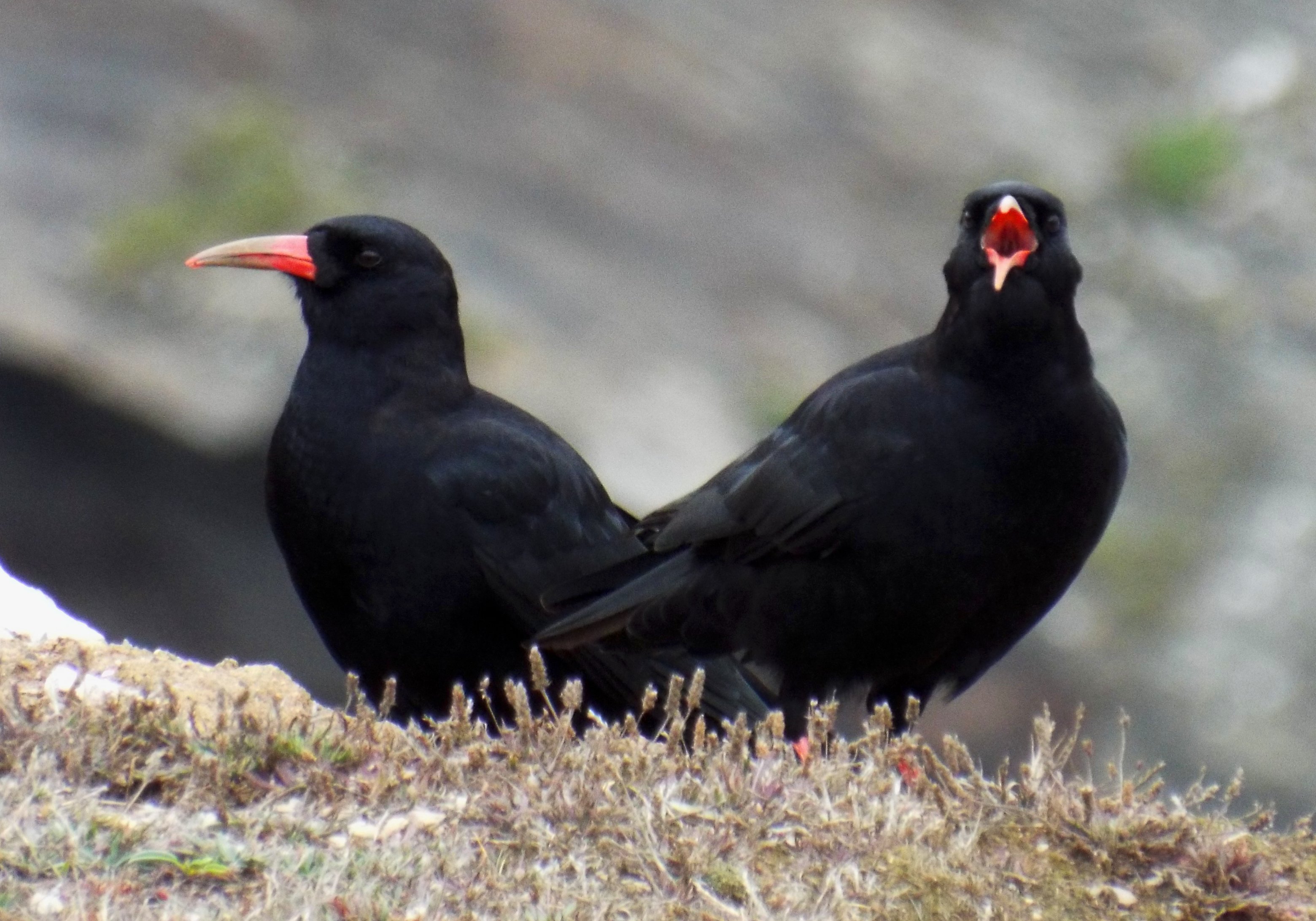
Red-billed Chough (Pyrrhocorax pyrrhocorax)

OTHER NAMES: Chough
Latin Etymology: Pyrrhocorax ("flame raven") pyrrhocorax ("flame raven")
Image
Two Red-billed Chough (subspecies P. p. pyrrhocorax) in Cornwall -September 2020

Featured Subspecies: Pyrrhocorax pyrrhocorax pyrrhocorax
Weight: 280-385g  /  Length: 39-40cm  /  Wingspan: 73-90cm
UK AMBER LIST / IUCN Red List: Least Concern

Red-billed Choughs are the rarest member of the crow family in the UK, having much more specialized habitats than any of the others.  Generally just known as chough in the UK for lack of Alpine Choughs in the country.  They require cliffs to next and generally prefer grazed land as their diet consists largely of insects found within the dung. Distinctive amoung British crows for their bright curved red beak, they are only found in Western Scotland, Wales, Ireland and a small, recently reestablished population in South-West Cornwall.  In Spain, they are a bit more common - still mostly found in areas with cliffs, but much more broadly, even to the point of being found on cliffs on the outskirts of Madrid itself.  They are strongly associated with Cornwall though within the UK, despite being absent from the country for nearly 30 years they remained the county bird and can be seen on the county coat of arms.

Related Species:
Order:
Passeriformes
Family: Corvidae
Genus: Pyrrhocorax
Subspecies: P. p. pyrrhocorax, P. p. erythroramphos, P. p. barbarus, P. p. docilis, P. p. centralis, P. p. himalayanus, P. p. brachypus, P. p. baileyi


 - Sighting Locations -
UNITED KINGDOM - Rare and local breeding resident in the North and West (250-350 pairs) plus 120-150 pairs on the Isle of Man.
 - Pair seen at Lizard Point in June 2012. At least eight at a less publically advertised site in September 2020.
SPAIN - Spanish - Chova Piquirroja ("Red beaked chough")
Widespread though rarely numerous resident in suitable habitats.
 - MADRID 2016 TRIP: Pairs seen at Monfrague National Park and Laguna Campillo

Further Notes: BirdForum OpusIUCN Red ListRSPBWikipedia, Xeno-canto .

Wednesday, 5 May 2010

Eurasian Reed Warbler (Acrocephalus scirpaceus)

OTHER NAMES: Reed Warbler
Latin Etymology: Acrocephalus ("topmost head") scirpaceus ("reed")
 Adult Eurasian Reed Warbler (subspecies A. s. scirpaceus) at Rainham Marshes, London - 2012

Featured Subspecies: Acrocephalus scirpaceus scirpaceus
Weight: 13g  /  Length: 12.5-14cm  /  Wingspan: 19cm
UK GREEN LIST / IUCN Red List: Least Concern

The Reed Warbler is comparatively one of the commoner species of Warbler in the UK, but given it's habitat it is generally quite a secretive species - if you see it there is a good chance it'll be flitting in and out of Reed beds. As with most warblers it is also a summer visitor, which means you only have a limited time frame each year to find them. However, in most suitable reed beds they can be fairly numerous and are less secretive than other commoner warblers.

Related Species:
Order:
Passeriformes
Family: Acrocephalidae
Genus: Acrocephalus
Subspecies: A. s. sciraceus, A. s. fuscus

- Sighting Locations -
UNITED KINGDOM - Locally common Summer migrant (130,000 birds)
 - Birds seen at Rutland Water and Rainham Marshes.
SPAIN - Spanish - Carricero común ("Common Reed Warbler")
Summer migrant
 - MADRID 2016 TRIP: A single bird seen in Laguna Campillo

.

Saturday, 15 August 2009

Eurasian Jackdaw (Corvus monedula)

OTHER NAMES: Jackdaw, Western Jackdaw, European Jackdaw, Caddaw
Latin Etymology: Corvus ("raven") monedula ("money eater")
Adult Eurasian Jackdaw (subspecies C. m. spermologus) at Trevose Head, Cornwall - June 2011

Featured Subspecies: Corvus monedula spermologus
Weight: 250g  /  Length: 34-39cm  /  Wingspan: 67-74cm
UK GREEN LIST / IUCN Red List: Least Concern

One of the more common members of the crow family, the jackdaw is also perhaps the tamest, or at least boldest, when it comes to getting close. It is the smallest of the black members of the crow family with a distinctive grey head with dark forehead. It does seem easiest to photograph in touristy spots - presumably because it is scavenging off of dropped food, though it has adapted well to life in many urban areas in general.

Related Species:
Order: Passeriformes
Family: Corvidae
Genus: Corvus
Subspecies: C. m. monedula, C. m. spermologus, C. m. soemmerringii, C. m. cirtensis  

- Sighting Locations -
UNITED KINGDOM - Abundant resident (1,400,000 pairs)
SPAIN - Spanish - Grajilla 
Resident
 - MADRID 2016 TRIP: Seen flying over Laguna Campillo. 

Further Notes: BirdForum Opus, IUCN Red ListRSPBWikipedia, Xeno-canto

.

Wednesday, 19 November 2008

Bryony ladybird (Henosepilachna argus)

OTHER NAMES: N/A
Latin Etymology: Henosepilachna argus

Adult Bryony Ladybird (Henosepilachna argus) at Laguna Campillo, Spain - April 2016

Featured Subspecies: ?
Length: 5-7mm
UK Status: Not Evaluated IUCN Red List: Not Yet Evaluated

The Bryony Ladybird is a species of ladybird that is specialised to specific species of plants - a vegetarian species which feeds on the leaves of bryony plants as well as melons, gourds, cucumbers marrows and so on.   While in the the UK it is limited around London for the most part.  This individual however was seen in Spain where it is a more common species.

Related Species: 
Order: Coleoptera 
Family: Coccinellidae 
Genus: Henosepilachna 
SUBSPECIES: None - monotypic

 - Sighting Locations -
SPAIN - Spanish - ?
A widespread resident
 - MADRID 2016 TRIP: A single individual at Laguna Campillo

Further Notes: BirdForum Opus, IUCN Red List, RSPB, Wikipedia, Xeno-canto .

Monday, 27 October 2008

Ocellated Lizard (Timon lepidus)

OTHER NAMES: Eyed Lizard, Jeweled Lacerta
Latin Etymology: Timon (?) lepidus ("neat" or "graceful")

Adult Occelated Lizard (subspecies T. l. lepidusat Laguna Campillo, Spain - April 2016

Featured Subspecies: Timon lepidus lepidus
Weight: 500g  /  Length: 30-60cm
NO UK STATUS IUCN Red List: Near Threatened

The Ocellated Lizard is the largest lizard in Europe, a species found throughout Iberia and Southern France.  It is a fairly omnivorous species, primarily feeding on beetles but will more broadly feed on anything it can find including bird's eggs, small vertebrates and plant matter as required.  The way to differentiate the males from the females are the blue spots on the flanks, but this individual wasn't interested in showing itself well

Related Species:
Order: Squamata
Family: Lacertidae
Genus: Timon
SUBSPECIES: T. l. ibericus, T. l. lepidus, T. l. nevadensis, T. l. oteroi 

 - Sighting Locations -
SPAIN - Spanish Lagarto Ocelado ("Ocellated Lizard")
A widespread resident
 - MADRID 2016 TRIP: A single individual at Laguna Campillo


Further Notes: BirdForum Opus, IUCN Red List, RSPB, Wikipedia, Xeno-canto .