Showing posts with label kettering. Show all posts

Sunday, 9 November 2014

Ring-necked Duck (Aythya collaris)

OTHER NAMES: N/A
Latin Etymology: Aythya (a seabird named by Aristotle) collaris ("of the neck")
Female Ring-necked Duck (Aythya collaris) at Wicksteed Park, Kettering - November 2014

Featured Subspecies: N/A
Weight: 690-790g  /  Length: 37-46cm  /  Wingspan: 63cm
No UK Status / IUCN Red List Least Concern

I must admit, this is a species I tracked down purely because it was very local to me rather than being particularly inspired by it.  It's a fairly widely distributed species in North America, found primarily in the Canada, USA and Mexico, migrating long distance the length of the continent.  This long distance travel makes it a prime candidate to get lost or blown off course to become a vagrant to Western Europe and apparently a couple tend to be present in the UK at any one time.  However, unfortunately this female is a fairly drab bird and difficult to pick out from across a lake amidst other brown female ducks.

Related Species:
Order: Anseriformes
Family: Anatidae
Genus: Aythya
Subspecies: None - monotypic

- Sighting Locations -
UNITED KINGDOM - A rare but regular vagrant from North America.
 - A single individual seen distantly at Wicksteed Park in Kettering in November 2014. 

Further Notes: BirdForum Opus, IUCN Red List, RSPB, Wikipedia, Xeno-canto .

Wednesday, 5 May 2010

Common Swift (Apus apus)

OTHER NAMES: Swift, Screamer, Devil-bird, Screech Martin
Latin Etymology: Apus ("swift") apus ("swift")
Adult Common Swift (subspecies A. a. apus) at Geddington, Northants - July 2012

Featured Subspecies: Apus apus apus
Weight: 35-56g  /  Length: 16-17cm  /  Wingspan: 38-40cm
UK AMBER STATUS / IUCN Red List: Least Concern

The swift is a widespread and common Summer visitor to the UK - it is larger than the unrelated swallows and martins and can be distinguished by having no easily visible white on it and it's long scythe blade shaped wings. The trick with this species is that it's very hard to photograph - the fundamental problem being that it is a species which it's a species which rarely willingly lands to the point where they sleep on the wing and furthermore is one of the fastest birds in the UK. In the end I have had to settle with manually focusing on somewhere where they are feeding and taking sequential photo's until a legible one turns up - quite possibly the most difficult "common" bird to photograph.

Related Species:
Order: Apodiformes
Family: Apodidae
Genus: Apus
Subspecies: A. a. apus, A. a. pekinensis

- Sighting Locations -
UNITED KINGDOM - Common Summer migrant breeder (87,000 pairs)
 - Seen at a large number of sites, including but not limited to Geddington, Kettering. Rutland Water and Rainham Marshes.
ITALY - Italian - Rondone
An abundant Summer migrant.
SICILY 2018 TRIP -  Very common throughout.
SPAIN - Spanish - Vencejo comĂșn ("Common Swift")
Abundant Summer breeding migrant
 - MADRID 2015 TRIP: Abundant over Madrid and Toledo.
 - MADRID 2016 TRIP: Common in Madrid and Monfrague National Park.
.

Tuesday, 1 December 2009

Water Rail (Rallus aquaticus)

OTHER NAMES: Western Water Rail
Latin Etymology: Rallus (latinized form of rail) aquaticus ("water living")
 Adult Water Rail (subspecies R. a. aquaticus) at Regent's Park, London - December 2009

Featured Subspecies: Rallus aquaticus aquaticus
Weight: 92-164g  /  Length: 23-28cm  /  Wingspan: 38-45cm
UK GREEN LIST / IUCN Red List: Least Concerned

The water rail is a secretive relative of the moorhen and coot which favours living in reed beds. It really is far more shy than it's more common neighbors, and thus is quite possibly under recorded. It is smaller than both, with a long thin red beak and a grey and brown colour scheme. Best views are achieved when they don't know you are there, as when alerted to your presence they slip straight back into vegetation.  It is probably easiest to see Water Rails in Winter - at this point food is scarcer and reeds die back, forcing them into the open more often.


Related Species:
Order: Gruiformes
Family: Rallidae
Genus: Rallus
Subspecies: R. a. hibernans, R. a. aquaticus, R. a. korejewi

- Sighting Locations -
UNITED KINGDOM - Common to Locally abundant Breeding Resident (9000 pairs) and Common Winter Visitor (41000 birds)

Further Notes: BirdForum Opus, IUCN Red List, RSPB, Wikipedia, Xeno-canto .

Monday, 16 November 2009

Goldcrest (Regulus regulus)

OTHER NAMES: Woodcock Pilot, Thumb bird, Golden Cutty
Latin Etymology: Regulus ("Kinglet/Prince") regulus ("Kinglet/Prince")
Adult Goldcrest (subspecies R. r. regulus) in Geddington, Northants - October 2010

Featured Subspecies: Regulus regulus regulus
Weight: 6.5g  /  Length: 8.5-9.5cm  /  Wingspan: 12.5-15.5cm
UK GREEN LIST / IUCN Red List - Least Concern

An attractive little bird, the goldcrest's main claim to fame is that it's the smallest bird in Europe. This brings with it some problems in photographing them - they are small, flit in and out of cover and manually focusing cameras don't like picking them up unless you have them in a clear field of view. They are however very widely spread, and numerous if you know where to look and it seems they can be found anywhere with a passable number of trees - particularly conifers. Parks with established trees are probably the best bet.

Related Species: 
Order: Passeriformes
Family: Regulidae
Genus: Regulus
Subspecies: R. r. regulus, R. r. azoricus, R. r. sanctaemariae, R. r. inermis, R. r. teneriffae, R. r. ellenthalerae, R. r. buturlini, R. r. hyrcanus, R. r. coatsi, R. r. tristis, R. r. himalayensis, R. r. sikkimensis, R. r. japonensis, R. r. yunnanensis   

- Sighting Locations -
UNITED KINGDOM - Fairly common breeding species (610,000 territories) and common Winter Visitor (3-5 million birds)
 - Most birds seen in Geddington though odd birds elsewhere..         

.

Sunday, 21 August 2005

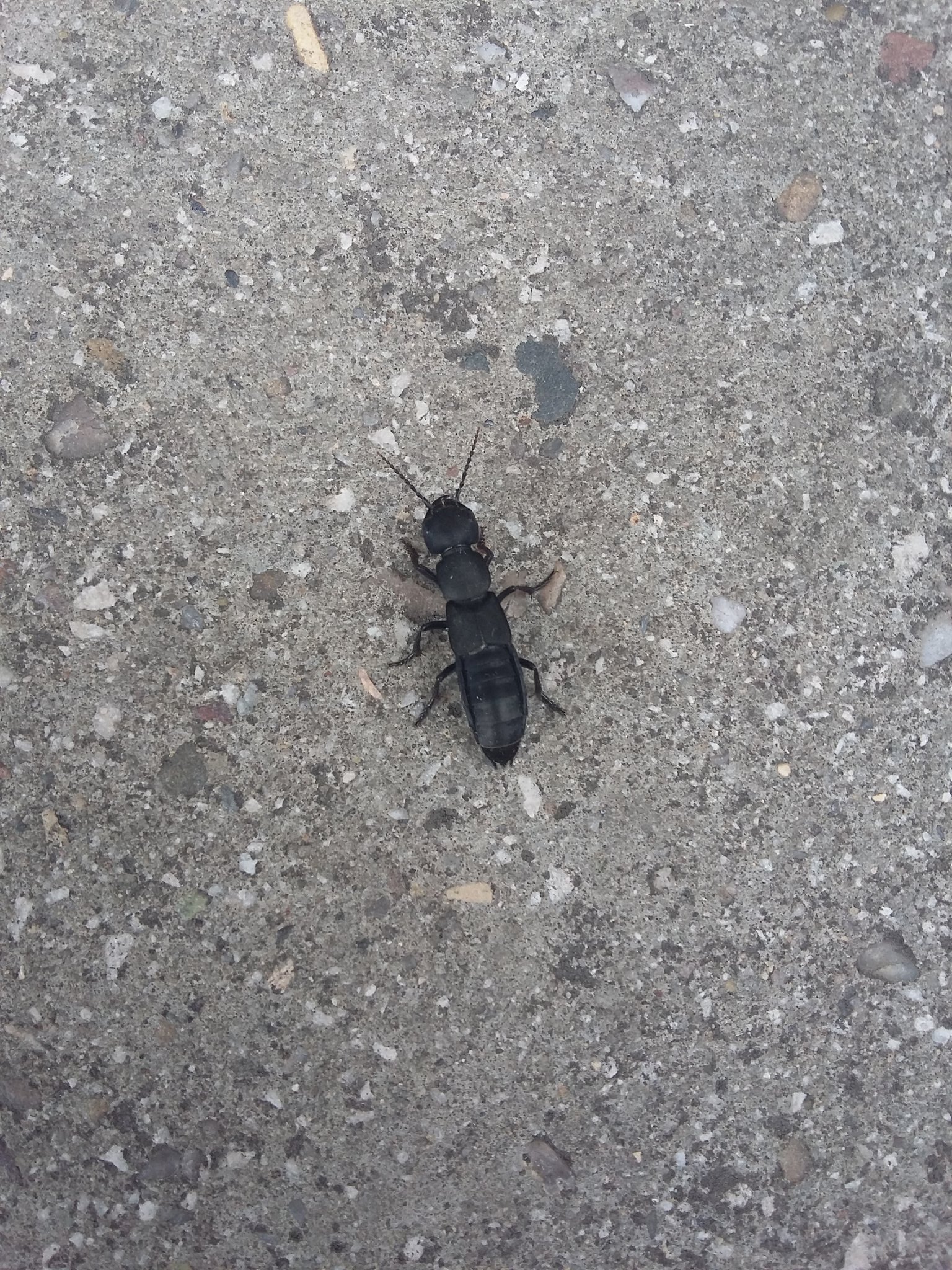
Devil's Coach Horse (Ocypus olens)

OTHER NAMES: Devil's Coach Horse Beetle, Devil's Footman, Devil's Coachman, Devil's Steed
Latin Etymology: Ocypus (?) olens ("smelling")
Image
Adult Devil's Coach Horse (Ocypus olens) at Kettering - August 2020

Featured Subspecies: ?
Weight: ?  /  Length: 20-26mm  /  Wingspan: ?
UK STATUS NOT EVALUATED/ IUCN Red List: Not Yet Evaluated 

A distinctive large beetle found in Europe and North Africa, it has drastically shortened wing cases (elyta) allowing for a flexible thorax that is will rear up in an almost scorpion like manner when threatened. It is associated with decaying natural materials where is lives during the day, emerging to hunt. The rather wonderfully dramatic name has a fairly long story - it has been associated with the Devil since the middle ages.

Related Species:
Order: Coleoptera
Family: Staphylinidae
Genus: Ocypus
SUBSPECIES: none - monotypic 

 - Sighting Locations -
UNITED KINGDOM - A common and widespread resident (April-October)
 - Seen in Kettering (August 2020),

Further Notes: BirdForum Opus, IUCN Red List, RSPB, Wikipedia, Xeno-canto
.

Sunday, 8 October 2000

Common Shiny Woodlouse (Oniscus asellus)

OTHER NAMES: Common Woodlouse, 
Latin Etymology: Oniscus ("little donkey") asellus ("little donkey")

Common Shiny Woodlouse (Oniscus asellus) at Kettering, Northants, UK - April 2025

Featured Subspecies: ?
Weight: ?  /  Length: 16mm  
NO UK STATUS / IUCN Red List: Least Concern

The most abundant species of woodlouse in Britain, as well as one of the largest in its range. A versatile species capable of living in many habitats as long as they provide the damp areas they need and an adequate food source.
 
Related Species: 
Order: Isopoda
Family: Oniscidae
Genus: Oniscus
SUBSPECIES: O. s. asellus, O. s. occidentalis
 
- Sighting Locations -

UNITED KINGDOM 
A widespread resident 

Further Notes: BirdForum Opus, IUCN Red List, RSPB, Wikipedia, Xeno-canto

.

Tuesday, 29 August 2000

Zebra Jumping Spider (Salticus scenicus)

OTHER NAMES: Zebra Spider
Latin Etymology: Salticus ("jump") scenicus ("theatrical")

Adult Zebra Jumping Spider (Salticus scenicus) at Kettering, Northants - June 2025

Featured Subspecies: ?
Weight: ?  /  Length: 5-9mm 
NO UK STATUS / IUCN Red List: Not Yet Evaluated 

A widely distributed and distinctive species of spider that hunts using powerful leap to catch prey rather than creating passive webs.  Instead they use their silk to create safety line attaching them to their point of origin so they may then return to it easily. They do not have muscles in their legs to power their jumps, but rather it uses controlled blood pressure to generate hydraulic forces, straightening the legs rapidly.
 
Related Species: 
Order: Araneae
Family: Salticidae
Genus: Salticus
SUBSPECIES: ?
 
- Sighting Locations -

UNITED KINGDOM - A widespread resident.
 - Seen in Kettering

Further Notes: BirdForum Opus, IUCN Red List, RSPB, Wikipedia, Xeno-canto

.